

Australia Olive Oil Market 2026-2034 | Size, Share, Report
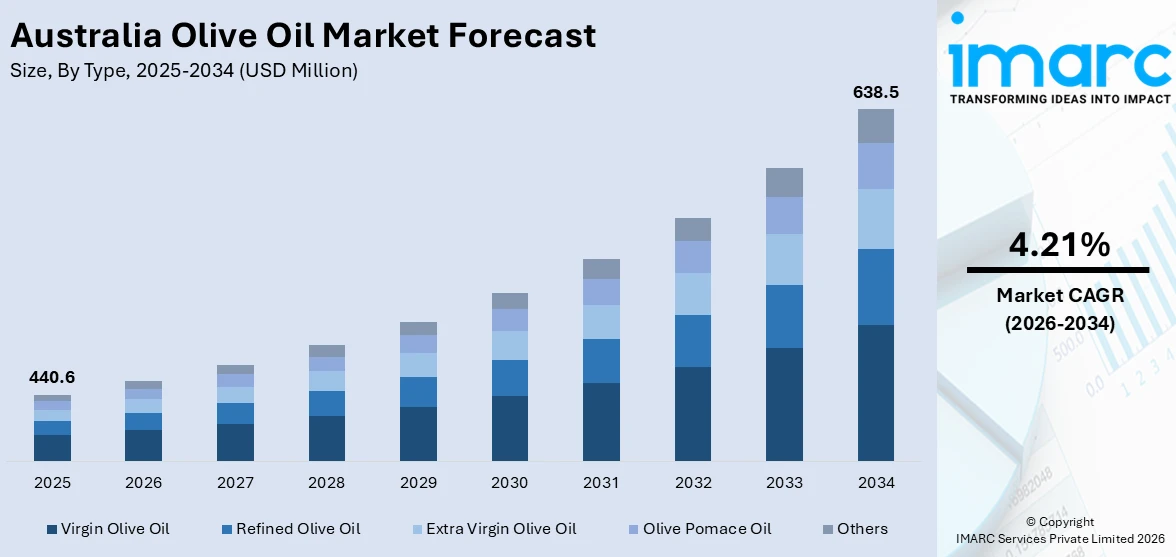
Australia olive oil market
Australia olive oil market size reached USD 440.6 Million in 2025, the market is expected to reach USD 638.5 Million by 2034, CAGR of 4.21% during 2026-2034.
AUSTRALIA, May 12, 2026 /EINPresswire.com/ --Market Size: USD 440.6 Million (2025)
Forecast: USD 638.5 Million (2034)
CAGR: 4.21% (2026–2034)
𝐀𝐮𝐬𝐭𝐫𝐚𝐥𝐢𝐚 𝐎𝐥𝐢𝐯𝐞 𝐎𝐢𝐥 𝐌𝐚𝐫𝐤𝐞𝐭 𝐎𝐯𝐞𝐫𝐯𝐢𝐞𝐰
The Australia olive oil market is experiencing sustained expansion, driven by intensifying health consciousness, shifting culinary preferences, and growing domestic production capabilities across the nation’s key olive-growing regions. The market is establishing itself as a premium segment within Australia’s broader edible oils landscape, combining high-quality domestic supply with evolving consumer demand for extra virgin, organic, and cold-pressed varieties. Production is thriving in Victoria, South Australia, New South Wales, and Western Australia, where Mediterranean-style climates are supporting world-class olive cultivation. With Australians consuming approximately 50,000 tonnes annually and domestic producers supplying roughly one-third of national demand, significant growth opportunities are emerging.
𝐖𝐡𝐲 𝐈𝐬 𝐭𝐡𝐞 𝐀𝐮𝐬𝐭𝐫𝐚𝐥𝐢𝐚 𝐎𝐥𝐢𝐯𝐞 𝐎𝐢𝐥 𝐌𝐚𝐫𝐤𝐞𝐭 𝐇𝐨𝐭 𝐓𝐨𝐝𝐚𝐲?
Australia’s olive oil sector is attracting exceptional attention as global supply disruptions are reshaping competitive dynamics and creating unprecedented export opportunities for domestic producers. Cobram Estate is reporting a bumper 2024–25 harvest of 14.2 million litres with EBITDA surging 75% to $116.6 million, while completing the landmark acquisition of California Olive Ranch for USD 473.5 million. USDA figures are confirming domestic production at 20,000–21,000 tonnes — the second-highest level since 2021/22 — while exports are rising to their strongest point in three years. Premium extra virgin varieties are commanding growing consumer preference as Mediterranean diet adoption accelerates nationwide.
𝐌𝐚𝐫𝐤𝐞𝐭 𝐆𝐫𝐨𝐰𝐭𝐡 𝐓𝐫𝐚𝐣𝐞𝐜𝐭𝐨𝐫𝐲 𝐚𝐧𝐝 𝐒𝐭𝐫𝐚𝐭𝐞𝐠𝐢𝐜 𝐎𝐩𝐩𝐨𝐫𝐭𝐮𝐧𝐢𝐭𝐢𝐞𝐬
The Australia olive oil market is witnessing a powerful convergence of premiumization trends, domestic production expansion, and international trade opportunities that is positioning the nation as a globally significant olive oil origin. E-commerce channels are enabling direct producer-to-consumer sales of specialty and limited-release products. Export corridors into Southeast Asia, the Middle East, and European markets are expanding as Australian producers leverage their reputation for clean agriculture and stringent quality standards. Sustainability-focused farming practices, biodiversity conservation, and recyclable packaging innovations are resonating with environmentally conscious consumers across metropolitan and regional markets.
𝐌𝐚𝐫𝐤𝐞𝐭 𝐆𝐫𝐨𝐰𝐭𝐡 𝐃𝐫𝐢𝐯𝐞𝐫𝐬
• Intensifying health consciousness among Australian consumers is driving structural demand for olive oil, particularly extra virgin varieties rich in antioxidants, monounsaturated fats, and polyphenols associated with cardiovascular and cognitive health benefits.
• Robust domestic production across Victoria, South Australia, New South Wales, and Western Australia is strengthening the supply base, with production reaching 20,000–21,000 tonnes annually and Cobram Estate harvesting a record 14.2 million litres in 2024–25.
• Accelerating adoption of Mediterranean diets and gourmet cooking culture is expanding olive oil usage beyond traditional applications into frying, roasting, baking, desserts, and specialty culinary preparations.
• E-commerce expansion and digital retail platforms are enabling direct producer-to-consumer sales channels, particularly for premium, single-origin, organic, and limited-release olive oil products.
• International export opportunities are growing as global supply disruptions from European producers create premium demand corridors in Southeast Asia, the Middle East, and North American markets for Australian olive oil.
Request a Business Sample Report for Procurement & Investment Evaluation:
https://www.imarcgroup.com/australia-olive-oil-market/requestsample
𝐋𝐚𝐭𝐞𝐬𝐭 𝐌𝐚𝐫𝐤𝐞𝐭 𝐍𝐞𝐰𝐬
• January 2026: Cobram Estate Olives completed the acquisition of California Olive Ranch for USD 473.5 million, positioning Australian olive oil expertise for accelerated international market expansion with 856 hectares of new grove development planned.
• September 2025: Australian and New Zealand olive oil producers raised concerns about the upcoming mandatory Health Star Rating system, warning that the methodology could undermine consumer education about extra virgin olive oil’s distinct health qualities.
• July 2025: Cobram Estate raised $178 million in capital to fund its US growth strategy, including the California Olive Ranch acquisition and new grove development in California.
• May 2025: Cobram Estate acquired Leda Ag, the manufacturer of olive harvesters, strengthening its vertically integrated supply chain from harvesting technology through to milling, storage, and branded retail distribution.
• November 2025: Cobram Estate reported a bumper 2024–25 harvest of 14.2 million litres, with group olive oil sales revenue reaching $237.4 million and EBITDA surging 75% to $116.6 million year-over-year.
𝐀𝐮𝐬𝐭𝐫𝐚𝐥𝐢𝐚 𝐎𝐥𝐢𝐯𝐞 𝐎𝐢𝐥 𝐌𝐚𝐫𝐤𝐞𝐭 𝐒𝐮𝐦𝐦𝐚𝐫𝐲 (𝐌𝐚𝐫𝐤𝐞𝐭-𝐋𝐞𝐯𝐞𝐥 𝐏𝐨𝐢𝐧𝐭𝐬)
• Extra virgin olive oil is commanding the dominant share of consumer preference, driven by premiumization trends, clean-label demand, and growing awareness of health benefits associated with cold-pressed, antioxidant-rich varieties.
• Domestic production is reaching 20,000–21,000 tonnes annually — supplying approximately one-third of Australia’s 50,000-tonne annual consumption — with significant headroom for import substitution and export growth.
• Supermarkets and hypermarkets are dominating the distribution landscape, while online stores are emerging as the fastest-growing channel enabling direct-to-consumer premium product sales.
• Victoria and South Australia are leading domestic production volumes, benefiting from Mediterranean-style climates, established grove infrastructure, and proximity to major processing and distribution networks.
• The food and beverage segment is accounting for the largest application share, with expanding usage across frying, roasting, baking, and gourmet preparations diversifying olive oil’s culinary footprint.
• Global supply disruptions from traditional European producers are creating a strategic window for Australian exporters, with exports rising to their strongest level in three years across Southeast Asian and Middle Eastern markets.
• Cobram Estate’s $473.5 million acquisition of California Olive Ranch signals accelerating consolidation and international expansion ambitions among Australia’s leading olive oil producers.
• Sustainability and traceability are emerging as key competitive differentiators, with consumers increasingly prioritizing eco-friendly farming, single-origin sourcing, harvest-date transparency, and recyclable packaging.
𝐇𝐨𝐰 𝐀𝐈 𝐈𝐬 𝐑𝐞𝐬𝐡𝐚𝐩𝐢𝐧𝐠 𝐭𝐡𝐞 𝐀𝐮𝐬𝐭𝐫𝐚𝐥𝐢𝐚 𝐎𝐥𝐢𝐯𝐞 𝐎𝐢𝐥 𝐌𝐚𝐫𝐤𝐞𝐭
Artificial intelligence is rapidly emerging as a transformative force across Australia’s olive oil industry, reshaping cultivation, harvesting, processing, quality control, and market distribution — with over 60% of large Australian farms now integrating AI-driven solutions for precision agriculture and resource management.
• AI-powered precision agriculture platforms are enabling olive grove operators to optimize irrigation scheduling, fertilization programs, and pest management through real-time analysis of soil moisture, weather data, and satellite imagery, boosting crop yield prediction accuracy by up to 30%.
• Machine learning-driven quality assessment systems are analyzing olive oil chemical profiles, polyphenol content, and organoleptic characteristics during extraction, enabling producers to classify and grade output with greater consistency and speed than traditional sensory panel methods.
• Smart harvesting technology integrating AI-controlled robotic systems and automated olive harvesters is reducing labor dependencies and optimizing harvest timing based on fruit maturity analysis, with Cobram Estate’s acquisition of Leda Ag signaling sector-wide automation acceleration.
• AI-driven demand forecasting and dynamic pricing tools are enabling olive oil producers and retailers to optimize inventory management, promotional strategies, and distribution logistics based on seasonal consumption patterns and market trend analysis.
• Blockchain-integrated traceability platforms powered by AI are enabling producers to provide end-to-end supply chain transparency from grove to shelf, supporting single-origin authentication, harvest-date verification, and anti-fraud measures demanded by premium consumers.
𝐌𝐚𝐫𝐤𝐞𝐭 𝐓𝐫𝐞𝐧𝐝𝐬 𝐚𝐧𝐝 𝐈𝐧𝐬𝐢𝐠𝐡𝐭𝐬
• Premiumization is driving a structural shift in consumer preferences toward extra virgin, organic, cold-pressed, and single-origin olive oil varieties, with transparent sourcing and harvest-date labeling becoming critical purchase decision factors in metropolitan markets.
• Australia’s domestic production infrastructure is expanding significantly, with Cobram Estate reporting record 14.2 million litre harvests and investing in new processing capacity including a $35 million state-of-the-art mill to capitalize on growing domestic and export demand.
• E-commerce and direct-to-consumer channels are reshaping distribution dynamics, enabling boutique and premium producers to bypass traditional retail intermediaries and access health-conscious urban consumers with specialty, infused, and limited-release olive oil products.
• Global supply disruptions from Mediterranean basin producers — driven by climate volatility affecting Spain, Italy, and Greece — are creating a strategic window for Australian exporters to penetrate premium international markets with competitively positioned, high-quality offerings.
• Sustainability-focused farming practices including water conservation, reduced chemical usage, biodiversity promotion, and recyclable packaging are becoming essential brand differentiators as environmentally conscious consumers drive purchasing decisions.
• Culinary diversification is expanding olive oil’s application footprint beyond traditional Mediterranean usage into mainstream Australian cooking including frying, roasting, baking, desserts, and specialty flavor-infused preparations for foodservice and retail.
𝐌𝐚𝐫𝐤𝐞𝐭 𝐆𝐫𝐨𝐰𝐭𝐡 𝐃𝐫𝐢𝐯𝐞𝐫𝐬 — 𝐃𝐞𝐭𝐚𝐢𝐥𝐞𝐝 𝐀𝐧𝐚𝐥𝐲𝐬𝐢𝐬
𝐇𝐞𝐚𝐥𝐭𝐡 𝐂𝐨𝐧𝐬𝐜𝐢𝐨𝐮𝐬𝐧𝐞𝐬𝐬, 𝐏𝐫𝐞𝐦𝐢𝐮𝐦𝐢𝐳𝐚𝐭𝐢𝐨𝐧, 𝐚𝐧𝐝 𝐌𝐞𝐝𝐢𝐭𝐞𝐫𝐫𝐚𝐧𝐞𝐚𝐧 𝐃𝐢𝐞𝐭 𝐀𝐝𝐨𝐩𝐭𝐢𝐨𝐧
Australia’s olive oil market is being propelled by powerful consumer health trends as awareness of olive oil’s cardiovascular, anti-inflammatory, and cognitive health benefits continues to intensify. Extra virgin varieties rich in polyphenols and monounsaturated fats are commanding premium pricing. The widespread adoption of Mediterranean dietary patterns across urban demographics is expanding olive oil’s role from a niche ingredient to a mainstream cooking essential, with culinary applications diversifying across frying, roasting, baking, and specialty preparations.
𝐃𝐨𝐦𝐞𝐬𝐭𝐢𝐜 𝐏𝐫𝐨𝐝𝐮𝐜𝐭𝐢𝐨𝐧 𝐄𝐱𝐩𝐚𝐧𝐬𝐢𝐨𝐧, 𝐄𝐱𝐩𝐨𝐫𝐭 𝐎𝐩𝐩𝐨𝐫𝐭𝐮𝐧𝐢𝐭𝐢𝐞𝐬, 𝐚𝐧𝐝 𝐈𝐧𝐝𝐮𝐬𝐭𝐫𝐲 𝐂𝐨𝐧𝐬𝐨𝐥𝐢𝐝𝐚𝐭𝐢𝐨𝐧
Australia’s olive oil production base is strengthening as favorable Mediterranean-style climates across Victoria, South Australia, and NSW support world-class cultivation. Domestic output is reaching 20,000–21,000 tonnes annually with exports at three-year highs. Cobram Estate’s $473.5 million California Olive Ranch acquisition and $178 million capital raising signal accelerating industry consolidation and international expansion. Global supply disruptions from European producers are creating premium export corridors into Southeast Asia, the Middle East, and North American markets.
𝐊𝐞𝐲 𝐓𝐫𝐞𝐧𝐝𝐬 𝐒𝐡𝐚𝐩𝐢𝐧𝐠 𝐭𝐡𝐞 𝐀𝐮𝐬𝐭𝐫𝐚𝐥𝐢𝐚 𝐎𝐥𝐢𝐯𝐞 𝐎𝐢𝐥 𝐌𝐚𝐫𝐤𝐞𝐭 𝐋𝐚𝐧𝐝𝐬𝐜𝐚𝐩𝐞 𝐈𝐧𝐜𝐥𝐮𝐝𝐞:
• Accelerating premiumization with extra virgin, organic, and cold-pressed varieties commanding growing market share as health-conscious consumers prioritize clean-label, antioxidant-rich products over refined alternatives.
• Domestic production expansion with record harvests, new processing infrastructure investments, and vertical integration strategies strengthening Australia’s position as a globally competitive olive oil origin.
• E-commerce and direct-to-consumer channel growth enabling premium producers to access urban health-conscious demographics with single-origin, specialty, and limited-release olive oil products.
• International export acceleration as global supply disruptions from Mediterranean basin producers open premium demand corridors in Southeast Asia, the Middle East, and North America.
• AI-powered precision agriculture and smart harvesting technology adoption transforming grove management, quality control, and supply chain efficiency across Australia’s olive oil production regions.
• Sustainability and traceability innovation with eco-friendly farming practices, harvest-date labeling, single-origin authentication, and recyclable packaging becoming critical competitive differentiators.
• Industry consolidation accelerating through strategic acquisitions, with Cobram Estate’s California Olive Ranch deal signaling the emergence of globally integrated Australian olive oil enterprises.
𝐊𝐞𝐲 𝐀𝐬𝐩𝐞𝐜𝐭𝐬 𝐑𝐞𝐪𝐮𝐢𝐫𝐞𝐝 𝐟𝐨𝐫 𝐀𝐮𝐬𝐭𝐫𝐚𝐥𝐢𝐚 𝐎𝐥𝐢𝐯𝐞 𝐎𝐢𝐥 𝐌𝐚𝐫𝐤𝐞𝐭:
• Product type segmentation analysis covering extra virgin olive oil, virgin olive oil, refined olive oil, olive pomace oil, and specialty/infused varieties with demand share distribution and pricing benchmarks.
• Distribution channel analysis across supermarkets and hypermarkets, convenience stores, online stores, specialty food retailers, and foodservice channels with growth trajectory assessments.
• Application segmentation covering food and beverage, pharmaceuticals, cosmetics, and industrial uses with volume and value share analysis for each end-use category.
• Regional demand distribution across ACT & New South Wales, Victoria & Tasmania, Queensland, Northern Territory & South Australia, and Western Australia with production-consumption balance analysis.
• Domestic production vs. import dependency analysis quantifying the approximately one-third domestic supply share against total 50,000-tonne annual consumption and import source diversification.
• Consumer preferences and demand behavior analysis covering premium/organic purchasing patterns, clean-label expectations, single-origin demand, and price sensitivity across demographic segments.
• Competitive landscape assessment covering major producers (Cobram Estate, Bovalina, Grampians Olive Co.), market share distribution, consolidation dynamics, and international expansion strategies.
• Supply chain and distribution structure mapping including grove acreage, harvest volumes, processing capacity, storage infrastructure, retail distribution networks, and export logistics.
• Export market analysis covering Southeast Asian, Middle Eastern, North American, and European demand corridors with pricing, volume, and competitive positioning assessments.
𝐌𝐚𝐫𝐤𝐞𝐭 𝐒𝐞𝐠𝐦𝐞𝐧𝐭𝐚𝐭𝐢𝐨𝐧
IMARC Group’s research categorizes the Australia olive oil market as follows:
𝐁𝐲 𝐓𝐲𝐩𝐞
• Virgin Olive Oil
• Refined Olive Oil
• Extra Virgin Olive Oil
• Olive Pomace Oil
• Others
𝐁𝐲 𝐃𝐢𝐬𝐭𝐫𝐢𝐛𝐮𝐭𝐢𝐨𝐧 𝐂𝐡𝐚𝐧𝐧𝐞𝐥
• Supermarkets and Hypermarkets
• Convenience Stores
• Online Stores
• Others
𝐁𝐲 𝐀𝐩𝐩𝐥𝐢𝐜𝐚𝐭𝐢𝐨𝐧
• Food and Beverage
• Pharmaceuticals
• Cosmetics
• Others
𝐁𝐲 𝐑𝐞𝐠𝐢𝐨𝐧
• Australian Capital Territory & New South Wales
• Victoria & Tasmania
• Queensland
• Northern Territory & South Australia
• Western Australia
𝐊𝐞𝐲 𝐏𝐥𝐚𝐲𝐞𝐫𝐬
The competitive landscape of the Australia olive oil market features a mix of large vertically integrated producers and boutique regional operators. Major companies include Cobram Estate Olives (ASX: CBO), Bovalina Group, Diana Olive Oil Holdings Pty Ltd, Frankland River Olive Company, Goldi, Grampians Olive Co., Great Southern Groves, It’s Olio AU, Mount Zero Olives, Oasis Olives, Penfield Food Co Pty Ltd, and The Australian Olive Company. Cobram Estate is the market leader with record $237.4 million sales revenue and a vertically integrated supply chain spanning grove management to branded retail distribution. Detailed profiles of all major companies are provided within the full IMARC Group research report.
𝐑𝐞𝐜𝐞𝐧𝐭 𝐍𝐞𝐰𝐬 𝐚𝐧𝐝 𝐃𝐞𝐯𝐞𝐥𝐨𝐩𝐦𝐞𝐧𝐭𝐬
April 2026: International Olive Council releases updated olive sector statistics confirming Australia’s production at 20,000–21,000 tonnes — the second-highest level since 2021/22 — with exports at their strongest point in three years.
January 2026: Cobram Estate Olives completed the acquisition of California Olive Ranch for USD 473.5 million, the leading producer of Californian extra virgin olive oil, and announced 856 hectares of new grove development in California to accelerate US market growth.
November 2025: Cobram Estate reported a bumper 2024–25 harvest of 14.2 million litres, up from 10.1 million litres the prior year, with group olive oil sales revenue reaching $237.4 million and EBITDA surging 75% to $116.6 million.
September 2025: Australian and New Zealand olive oil producers raised concerns about the upcoming mandatory Health Star Rating system, warning the methodology could undermine consumer education about the distinct health qualities of extra virgin olive oil.
July 2025: Cobram Estate raised $178 million in capital through an institutional placement to fund its US growth strategy, including the California Olive Ranch acquisition and new grove development in California.
May 2025: Cobram Estate acquired Leda Ag, the manufacturer of olive harvesters, strengthening its vertically integrated supply chain from harvesting technology through milling, storage, and branded retail distribution.
Browse the Full Report with TOC & List of Figures: https://www.imarcgroup.com/australia-olive-oil-market
𝐂𝐮𝐬𝐭𝐨𝐦𝐢𝐳𝐚𝐭𝐢𝐨𝐧 𝐎𝐩𝐭𝐢𝐨𝐧𝐬 𝐀𝐯𝐚𝐢𝐥𝐚𝐛𝐥𝐞 𝐟𝐨𝐫 𝐀𝐮𝐬𝐭𝐫𝐚𝐥𝐢𝐚 𝐎𝐥𝐢𝐯𝐞 𝐎𝐢𝐥 𝐌𝐚𝐫𝐤𝐞𝐭:
• Regional analysis by state/territory including ACT & NSW, Victoria & Tasmania, Queensland, NT & SA, and Western Australia with city-level consumption and production breakdowns.
• Market segmentation customization by type (extra virgin, virgin, refined, pomace), distribution channel, application, and price tier (economy, mid-range, premium, ultra-premium).
• Domestic production vs. import analysis quantifying local supply against total consumption, import source countries (Spain, Italy, Greece), and import substitution opportunities.
• Export market analysis covering Southeast Asian, Middle Eastern, North American, and European demand corridors with volume, pricing, and competitive positioning assessments.
• Product type deep-dive covering extra virgin, organic, cold-pressed, infused, and specialty olive oil variants with consumer preference mapping and pricing benchmarks.
Other Report by IMARC Group:
Australia Dairy Market 2026-2034: https://www.imarcgroup.com/australia-dairy-market
Australia Organic Food Market 2026-2034: https://www.imarcgroup.com/australia-organic-food-market
Australia Chocolate Market 2026-2034: https://www.imarcgroup.com/australia-chocolate-market
Australia Functional Gummies Market 2026-2034: https://www.imarcgroup.com/australia-functional-gummies-market
Elena Anderson
IMARC Services Private Limited
+ +1 201-971-6302
email us here
Legal Disclaimer:
EIN Presswire provides this news content "as is" without warranty of any kind. We do not accept any responsibility or liability for the accuracy, content, images, videos, licenses, completeness, legality, or reliability of the information contained in this article. If you have any complaints or copyright issues related to this article, kindly contact the author above.
